
Image featured above: Schloss Gumpoldskirchen and Ried Hofpoint located in Austria’s Thermenregion. ©AWMB/WSNA.
Si prefieres leer este artículo en español, haz clic aquí.
With the designation of Thermenregion as a DAC, Austria’s DAC family is now complete with eighteen DACs.
Estimated reading time: 2 minutes
The Austrian Wine Marketing Board (AWMB) announced in a press release dated 01 June 2023 that the country’s Thermenregion has been awarded DAC status. Thermenregion is the last of Austria’s major wine producing regions to attain DAC status. Beginning with the 2023 harvest, wine producers will be allowed to label their wines as “Thermenregion DAC” if the wines are produced according to the newly established regulations of the region. All wine producers in the region applying for DAC status for their wines must submit the wines to be evaluated and tasted by a panel of specialists. Wines which pass the evaluation will be allowed to show the phrase “Thermenregion DAC” on the label; wines which do not qualify will be labeled with the name of the generic winegrowing region (name of federal state) only, in this case, “Niederösterreich”. Tastings of the first Thermenregion DAC wines are planned for the spring of 2024.
What does DAC mean?
DAC, the abbreviation for Districtus Austriae Controllatus (Latin for “Austrian Controlled District”), is the Austrian equivalent to the European Union’s Protected Denomination of Origin (PDO). Similar designations exist in other member nations of the EU, for example, France’s Appellation d’Origine Contrôlée (AOC). The DAC system was legally defined in 2001, and in 2003 Austria’s Weinviertel region was the first to be granted DAC status for its dry Grüner Veltliner wines beginning with the wines of the 2002 harvest. Each region’s DAC law establishes permitted grape varieties, quality levels (some DACs also permit “reserve” wines or the mention of a village or individual vineyard name), alcohol content, residual sugar content, flavor profile, labelling guidelines, and dates when the wines may first be sold to the public. The core idea is that a wine labeled as a DAC will exhibit characteristics typical of the region. Typicity is key.
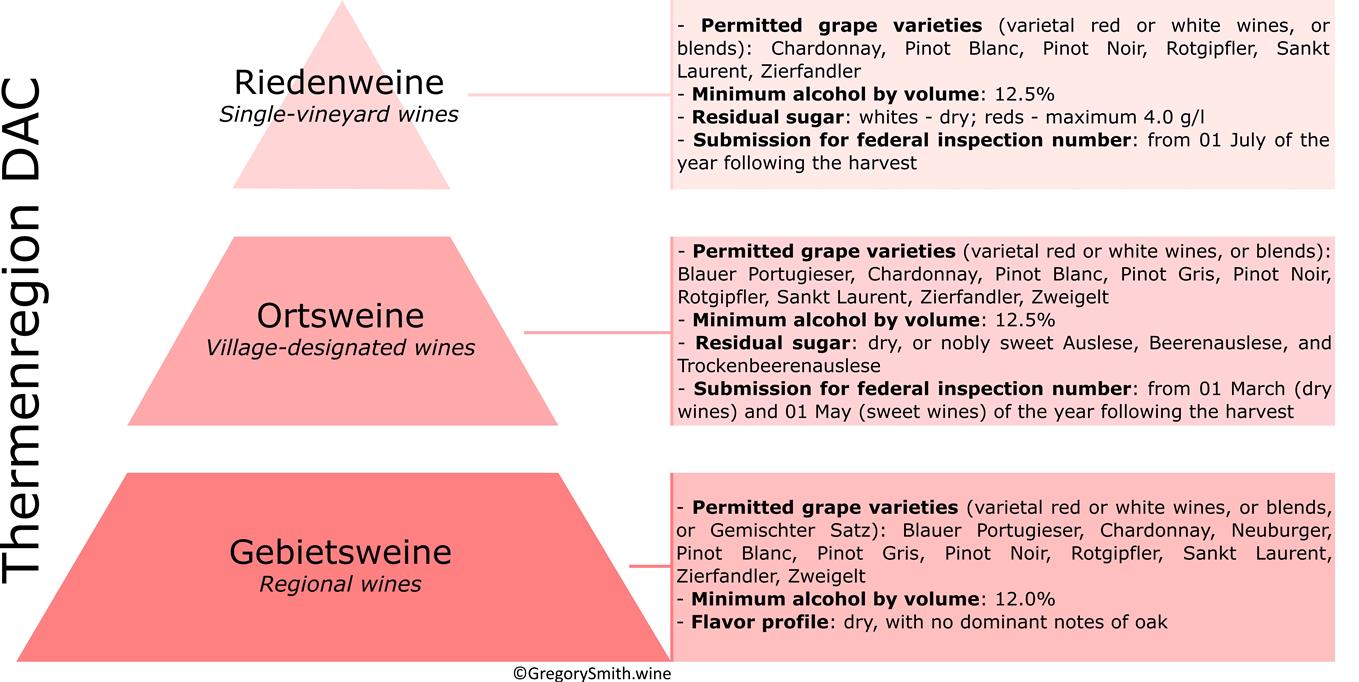
The Thermenregion DAC wines are further classified according to the three-tier quality pyramid. At the pyramid’s base are the regional wines (“Gebietsweine” in German), which are simply labelled “Thermenregion DAC” along with the grape variety. Village-designated wines (“Ortsweine” in German) are the mid-tier wines. The villages permitted to show their name on the label are Bad Vöslau, Gumpoldskirchen, Perchtoldsdorf, Tattendorf, and Wiener Neustadt. The top-tier wines of the pyramid are the single-vineyard designated wines (“Riedenweine” in Austrian German). The Thermenregion DAC rules also allow for extending the boundaries of certain municipalities. For example, wines produced in the municipalities of Guntramsdorf, Mödling, Pfaffstätten, and Traiskirchen may be labeled as “Thermenregion DAC Gumpoldskirchen” if they meet the established DAC requirements. Refer to the pyramid below for additional details.
For a brief history of Austrian wine, please visit: https://gregorysmith.wine/2021/04/06/a-brief-history-of-austrian-wines/
For more information on Austria’s grape varieties, please visit:
https://gregorysmith.wine/2021/05/30/the-grape-varieties-of-austria-part-1/
https://gregorysmith.wine/2023/03/29/the-grape-varieties-of-austria-part-2/
Kind thanks to the Austrian Wine Marketing Board for the data cited in this article.
COMING SOON
The strange story of Austria’s black sheep of wine, Uhudler, and why native American grape varieties ended up in Europe.
Ready to plan your trip to Austria? I’m ready to help! Inquiries about wine tours at gregory @ gregorysmith.wine.
Home | About | Contact | Consulting | Events | Education | Enotours | Recipes | Blog
 Gregory Smith
Pingback: La Thermenregion de Austria se convierte en el decimoctavo DAC del país – Gregory Smith
Great article!
LikeLike